Indoor cycling on a smart trainer: 5 practical training benefits
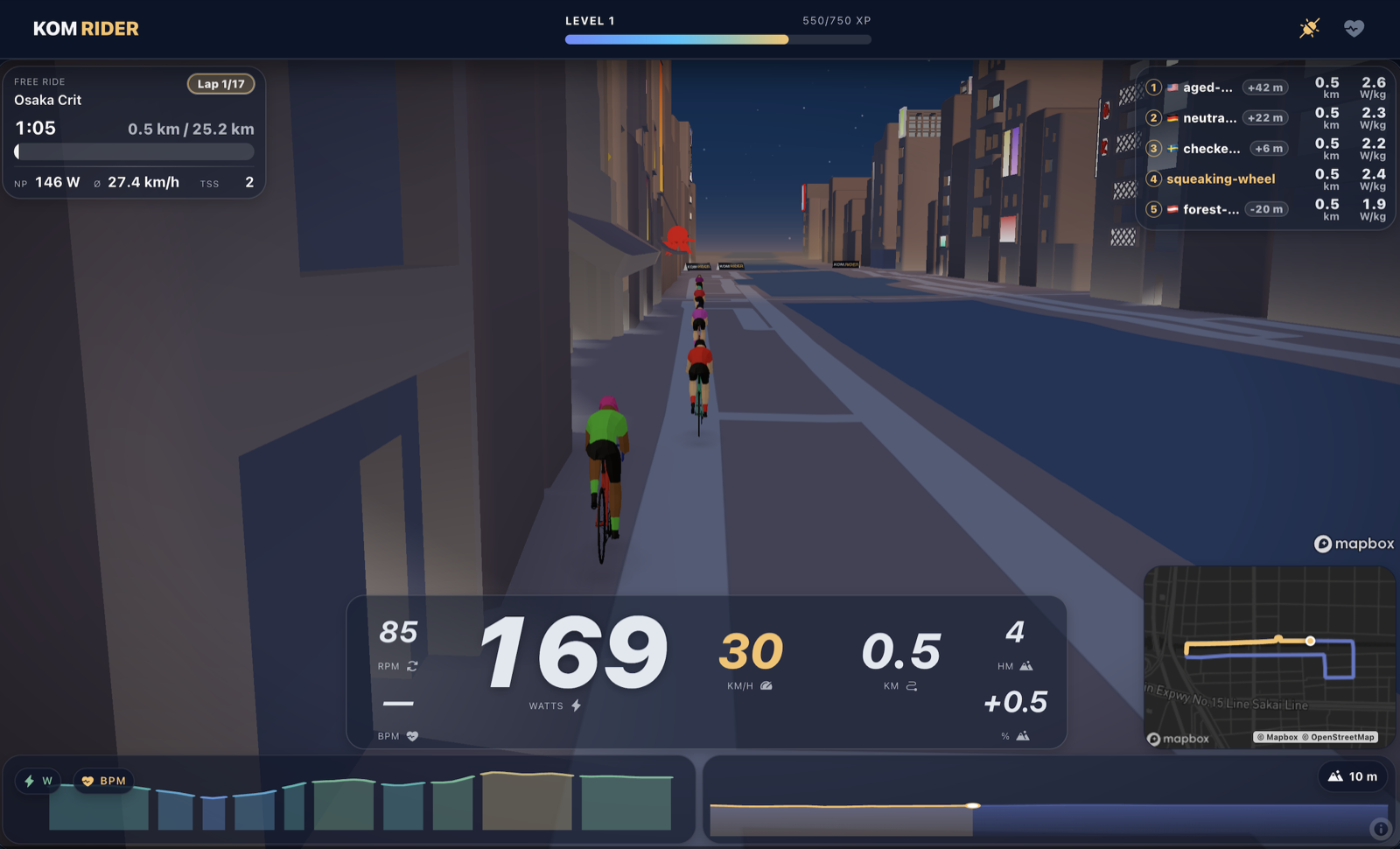
Indoor cycling is more than a winter fallback. A smart trainer makes sessions predictable, repeatable and independent of traffic or weather. It does not have to mean staring at the same wall either: KOMRIDER combines precise workouts with your own real routes in a virtual 3D world.
I have used an indoor trainer for years alongside road racing and triathlon. Its greatest benefit is choice: a precisely controlled ERG session today, the GPX course of an upcoming event tomorrow, and a relaxed virtual ride on an easier day.
1. More productive training time
An outdoor ride requires clothing, lights, route and weather checks, and sometimes cleaning the bike afterwards. On an indoor trainer, you can start within minutes. That matters when work and daily life leave only 45 to 60 minutes.
Saving time alone does not create a good session. Define the purpose before starting: endurance, threshold, short VO2max intervals or deliberate recovery. This turns a convenient ride into focused training.
2. Uninterrupted power targets in ERG mode
Traffic lights, descents and traffic interrupt outdoor intervals. In ERG mode, the workout sets a power target and a compatible Bluetooth smart trainer adjusts resistance automatically. You can complete a work block steadily without constant shifting.
A simple example for a rider with a 250-watt FTP:
- 10 minutes easy warm-up
- 3 × 10 minutes at 220 to 225 watts
- 5 minutes easy between efforts
- 10 minutes cool-down
This is not an individual training prescription. It illustrates why indoor sessions are so repeatable. Start with a realistic FTP and reduce the target if cadence collapses. Read ERG mode on a smart trainer for the full explanation.
3. Your real route becomes a virtual 3D world
Virtual cycling is often associated with fixed game worlds or route videos. KOMRIDER takes another approach: import a suitable GPX file or use an available Strava route. The app turns it into an elevation profile, trainer control and a rideable 3D environment with a virtual rider.
You are not limited to worlds built by a platform, and your local loop, mountain pass or race course does not need a pre-recorded video. A virtual ride can be created wherever a plausible route and sufficient map and elevation data are available.
This is useful for preparation. Where does the long climb begin? Which ramp encourages an overly hard start? Where can you recover? The simulation cannot reproduce cornering or road surface, but it makes the workload familiar. See Ride a GPX route on your smart trainer for the detailed guide.
4. Compare results under repeatable conditions
Indoor conditions are easier to reproduce than an outdoor loop. You can repeat the same route or workout without wind, traffic or a changed course dominating the comparison. That makes changes in pacing and fitness easier to interpret.
Do not judge a ride only by average power. Ask:
- Does cadence remain stable in the final intervals?
- Does heart rate rise sharply at the same power?
- Do you start a virtual climb under control?
- Can you complete several segment repetitions consistently?
5. Controlled conditions with three training choices
Rain, ice, darkness and heavy traffic can make a planned ride unsafe or impractical. Indoors, duration and environment are easier to control. This does not replace outdoor skills: bike handling, fueling on the road and riding in wind still require real rides.
KOMRIDER offers three useful approaches:
- Route mode: the gradient of the virtual route determines the workload.
- ERG workout: prescribed power targets control the trainer.
- Hybrid training: you ride through a virtual route while the workout controls power.
Practical setup checklist
- Position a fan before starting.
- Keep a drink and towel within reach.
- Wake the trainer and connect it by Bluetooth.
- Make sure another app is not already holding the trainer connection.
- Choose the session goal and intensity before riding.
- Check GPX distance and elevation for obvious outliers.
- Record two short notes about effort and pacing afterwards.
If pairing is not ready, follow Setting up your smart trainer.
Limits to know before downloading
KOMRIDER controls compatible trainers through Bluetooth FTMS. ANT+ is not supported. The training app is currently available for Windows and macOS, while a mobile app is in development. A custom route is also only as reliable as its GPS and elevation data; tunnels, bridges and bad points can require inspection before riding.
Conclusion
An indoor trainer works best as a focused complement to outdoor cycling. Use it for precise intervals, repeatable tests and preparation for specific routes. KOMRIDER adds a distinct idea: your real route becomes a virtual 3D ride instead of limiting you to fixed worlds or existing videos.
Markus Wilhelm develops KOMRIDER and brings experience from road racing, triathlon and years of indoor training to the product and its content.